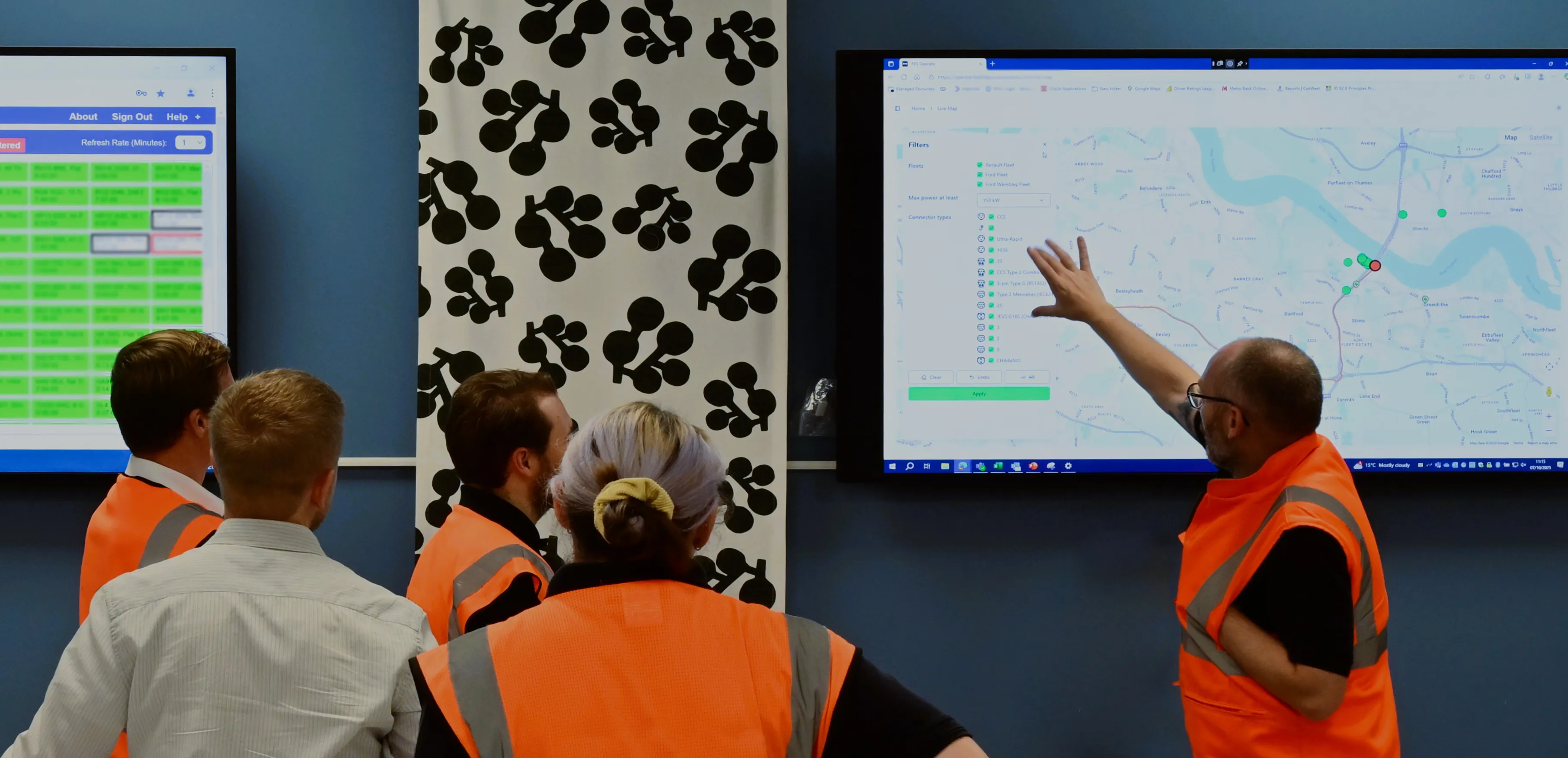
FPS Operate underpins scalable operating model of the future in support of multimillion pound 3PL investment in electric vehicle technology for zero emission last mile delivery.
Third Party Logistics (3PL) operators are a foundational component of the supply chain. As demand for zero-emission delivery grows, 3PLs must build and evolve “future fleets” while maintaining resilient, efficient, and sustainable operations. This means navigating the long-term challenges of net zero delivery, infrastructure constraint and rapid technological change.
The challenge
Our 3PL partner operates a 100% electric fleet comprising 22 16-tonne Renault eTech rigid trucks and 104 four-tonne electric vans, fulfilling last mile B2C furniture deliveries throughout Greater London and Southeast England.
Electric vehicles introduce new operational considerations, from range management and charging availability to energy costs and driver experience. This requires sophisticated daily charging strategies that balance depot-based and public network charging. Such strategies must also account for weather conditions, driving styles, vehicle loading, traffic, and route profiles.
The operation faced a number of specific challenges:
-
Highly variable route profiles and vehicle range capabilities
-
Unreliable state of charge forecasting that could vary substantially in short time periods
-
Challenges accessing public charging due to fragmented EV network provision
-
Significant costs from excess mileage and lost time arising from incorrect public charger selection
-
Inflated charging costs incurred on public networks versus depot charging, as well as time lost navigating to public charge points
-
Administrative burden from transport office time spent managing EV operations
-
Relatively high rates of driver turnover and limited experience in managing EVs
-
Fragmented data ecosystem requiring information from multiple systems to be reviewed before decisions could be made.
The 3PL’s requirement was to achieve a reduction in fulfilment costs by avoiding outcomes associated with poor charging planning: excess use of the public charging network, unnecessary diversion miles, time lost to unplanned charging, and excessive manual traffic office oversight.
The solution
Through live test and learn trials, emerging solutions could be validated across a range of stakeholders, thereby embedding both acceptance and innovation. The collaborative, future focused approach ensured that technology, infrastructure and people evolved together.
Electrification was treated as a system level challenge across multiple components of the transport operation, rather than a vehicle only solution. Advanced electric vans and rigid trucks are supported by intelligent charging infrastructure and real-time energy and route optimisation that improve resilience, efficiency and operational insight.
FPS worked closely with our innovative 3PL to implement a new variant of our FPS Operate real-time vehicle and charger management platform: an advanced vehicle and charger management platform which brings together vehicle telemetry, depot charger usage, route planning data, e-fuel card information and public charging availability into a single operational view, in a real-world environment.
In addition to these core functions, the platform performs an array of automated vehicle efficiency, cost and emissions savings analytics that the fleet operations team use to inform both short-term tactical and longer-term strategic decision making.
After a year of collaborative working to provide real-world insights into the home delivery operation and 3PL’s system level approach, FPS was requested to extend Operate’s functionality to assess automatically whether planned routes would require en-route charging and, where necessary, recommend optimal charging locations and durations based on least route deviation, driver time costs, vehicle state of charge and network compatibility. This minimises both lost time and unnecessary miles travelled.
Charging strategies are created by the platform and informed by live operational data, ensuring infrastructure investment aligns with real-world fleet demand and customer service requirements.
Operate also monitors vehicle range in real-time. This allows 3PL to identify easily vehicles with range issues and to deploy the automated recommendation of compatible public charging points thereby reducing the risk of stranded vehicles or poor charging choices.
The platform delivers three core functions:
-
Unified data integration – brings vehicle telemetry, depot charger usage data, route plan details, fuel card data and public charger information into one place, making data easily accessible to Traffic Office operatives through a single application.
-
Intelligent charge planning – ingests upcoming routes from the Aptean transport management system and automatically assesses whether an en-route charge is needed. When public network use is required, the system recommends an optimal charging location based on least diversion from the planned route, plus a recommended charging duration.
-
Real-time monitoring and intervention – monitors live state of charge and computes remaining range more reliably than onboard estimates, allowing the transport office to identify easily vehicles whose remaining range is likely to become problematic and automatically recommending nearby chargers from compatible public networks.
Impact
The FPS Operate platform delivers substantial operational and financial benefits across the fleet:
-
Consolidation of fleet management software solutions
-
Optimised use of public charging networks saving £1,700 per vehicle, per year
-
Reduction in route mileage of 6%
-
Minimisation of management time and removal of standby crews due to reliable vehicle returns, with demonstratable efficiencies achieved
-
A 95% reduction in vehicle recovery operations
-
Lower vehicle downtime due to the prevention of failed depot charging sessions.
Collectively, these improvements deliver more than £450,000 in recurring annual savings.
Beyond these direct operational cost savings, the platform is key to making EVs economically feasible in this operation. Running a fully electric fleet avoids around another £468,000 per year in fuel costs compared to diesel equivalents, resulting in overall savings approaching £1 million, while eliminating upwards of 1,100 tonnes of CO₂e in emissions every year across the fleet.
FPS Operate as Change Agent
Demonstrating a long-term partnership approach, we work closely with operational teams and drivers to develop intuitive, trusted systems that are embedded into daily operations.
FPS Operate removes the need for traffic offices to manually reconcile fragmented data sources and has created the foundation for increasingly automated decision making. This capability is critical as electric fleets scale, enabling all fleets to minimise unnecessary mileage, control charging costs and reduce operational risk associated with manual planning in a constrained infrastructure environment.